

Uncategorized
end impunity, Media News, Press Release, Uncategorized
Deteriorating US press freedom sparks visit by IFEX members
Sparked by growing concerns about the climate for press freedom in the US, leaders of six international organisations—the Committee to Protect Journalists (CPJ), IFEX, Reporters Without Borders (RSF), ARTICLE 19, Index on Censorship, and the International Press Institute (IPI)—will conduct a fact-finding visit to the country from 15 to 19 January. The mission includes participation in the Assessment of Press Freedom event at the Newseum on Wednesday, 17 January at 7:00 p.m. EST, in Washington, and meetings with high-level policymakers on 18 and 19 January. IFEX Campaigns 15 January 2018 https://youtu.be/nJDSgSRqUdI The live stream of the Newseum’s Assessment of Press Freedom event will be available here at 7:00 p.m. EST on 17 January 2018. “Members of IFEX know from experience that efforts to control, degrade and disable a free press will always be met with great gestures of solidarity and resistance, and it will be no different in the U.S. “ – Annie Game, IFEX Executive Director What happens in the US affects us all. Our freedom to know, to criticize and to question those who hold power over us is reliant on the free flow of pluralistic and independent information. In our ever-smaller world, some domestic policies can be felt as keenly abroad as at home. The Trump trend of anger at the press is not just fodder for TV satire. It must be checked. We must all advocate for a flourishing plural and independent media landscape for the US and the world. IFEX members routinely participate in missions to countries of concern for press freedom. The goal of this mission is to draw attention to the deterioration of press freedom in the US, as well as to promote solidarity among the global journalism community and their colleagues in the US. POSTED IN: United States Attacks Freedom of Assembly
Opportunities for Journalists, Uncategorized
Vacancy for Media Monitors
The International Press Center (IPC), Lagos requires the services of media monitors. The monitors are to be engaged under component 4b- Support to Media of the project titled: EU Support to Democratic Governance in Nigeria (EU-SDGN) being implemented by IPC for a 52-month period. The monitors will however monitor ten newspapers and two online media over a 24-month period between 2018 and 2020. The monitoring activity would help to provide scientific and evidence backed information on media performance in the coverage of electoral processes and the 2019 elections. The outcomes shall also be used to engage journalists and media gatekeepers on the need to adhere to professional and ethical standards. Job Requirements: Education A minimum of a University Degree or Higher National Diploma in any discipline. Previous experience in media monitoring will be an added advantage. Qualities Interest in and understanding of news and media reports Good understanding of governance, political and electoral issues Excellent analytical and writing skills. Proficiency is use of MS Word and Excel Proficiency in English language (speaking & writing) Experience with a wide array of social media platforms, such as Facebook and Twitter. Interested candidates should kindly send a copy of their CV with a cover letter to: admin@ipcng.org on/before Monday, January 22, 2018. The applications shall be reviewed and successful applicants will be contacted.
Uncategorized
Media Rights Agenda Calls on Federal Government to Halt Clampdown on Online Media
Lagos, Monday, November 6, 2017: Media Rights Agenda (MRA) has called on the Federal Government to halt its reported efforts to shut down online newspapers, blogs and websites perceived to constitute a “threat to national security”. Describing the move as a brazen violation of the Constitution and Nigeria’s international human rights obligations, MRA threatened to lodge a complaint against Nigeria before regional and international human rights bodies if the Federal Government does not put a stop to the plan. In a statement in Lagos, MRA’s Executive Director, Mr Edetaen Ojo, said the surreptitious moves to clamp down on online media, attributed to the Nigerian Communications Commission (NCC), acting on the instructions of the National Security Adviser (NSA) to the President, constitute an affront to basic human rights norms and standards which guide the actions of all civilized nations. Mr. Ojo said: “The Nigerian government, represented by the NSA and the NCC, cannot constitute itself into an accuser, judge and executioner in violation of the rights to freedom of expression and fair hearing, guaranteed by our Constitution as well as regional and international human rights instruments to which Nigeria is a party. Their actions constitute a shameless abuse of power by the Federal Government as evidenced by the underhand methods that they have adopted in carrying out their nefarious activities.” MRA said it is inclined to believe that the plan and its implementation are the handiwork of a few rogue officials of the Federal Government and that it does not have government-wide or presidential support, particularly in the light of the strong denial by the Minister of Communications, Mr. Adebayo Shittu, of any knowledge of the plan and his disavowal of the move. It therefore called on President Muhammadu Buhari, to unequivocally distance his Administration from such a brazen violation of the rights of Nigerians to freedom of expression, access to information and fair hearing and immediately put a stop to the move. MRA said if the Federal Government continued with the patently illegal plan, the organization would have no choice but lodge the appropriate complaints before the relevant regional and international human rights mechanisms, a course of action which may prove embarrassing for the government. The media reported over the weekend that the Federal Government, acting through the NCC, had engaged the services of a private company in Lagos to block the domain names of “several identified websites threatening national security”. The government directive is reported to have come from the Office of the National Security Adviser who has compiled a list of at least 21 “offending” websites, blogs and online publications that should be blocked for alleged threat to national security. But MRA insisted in its statement that the National Security Adviser has no authority to make such a determination as only a properly constituted court can determine whether any organization or person is in violation of any law for which punitive action should be taken against them. The organization also stressed that NCC acting on the instructions of the National Security Adviser without the due process of law is violating the constitution and the rights of Nigerians to freedom of expression including the right to receive information as stated in Article 19 of the International Covenant on Civil and Political Rights (ICCPR) which guarantees that “Everyone shall have the right to freedom of expression; this right shall include freedom to seek, receive and impart information and ideas of all kinds, regardless of frontiers, either orally, in writing or in print, in the form of art, or through any other media of his choice.” MRA argued that the NSA has no authority over the NCC which is an agency established by law. It noted that it is clear from the Nigerian Communications Commission Act of 2003 that the person duly authorized by law to supervise and instruct the NCC is the Minister of Communication, who has said that he is not aware that any memo originated from the NCC instructing any firm to gag the press, particularly online newspapers, Internet and social media users, or to shut them down. The Minister also stated that he had given no such instruction and that no instruction would be given to the NCC without such passing through him as the Minister supervising the NCC. MRA therefore contended that any other instruction to the NCC coming from any other source, including the NSA, is illegal. It called on the Federal Government to abide by its international commitments as a State Party to the Universal Declaration of Human Rights (UDHR) and the ICCPR, and urged it to commit itself to following the due process of the law. According to MRA, if the Federal Government has any reason to believe that any person or institution has committed an offense or is about to commit an offense under any written law in operation in Nigeria, its recourse is to bring that person or institution before a duly constituted court of law and not to resort to taking the laws into its own hands. For further information, please contact: Ridwan Sulaimon Programme Manager, Freedom of Information Media Rights Agenda, Lagos E-mail: sulaimon@mediarightsagenda.org

Press Release – International Day to End Impunity for Crimes Against Journalists: IPC Demands Justice for Attacked Journalists
The International Press Centre (IPC), Lagos-Nigeria has said there should be urgent justice for all attacked journalists in the country through investigation and diligent prosecution of the alleged perpetrators. IPC made the call today as journalists, other media professionals and freedom of expression groups mark the International Day to End Impunity for Crimes against Journalists. IPC said it was unfortunate that Nigeria continues to rank high among countries where press freedom and freedom of expression are under threat stating that the database of its Safety Alert Desk reveals not less than fourteen incidents of assault, threat, battery, arrest, kidnap, killing and invasion involving journalists and media institutions within the last one year. These include: Jerry Edoho of Ibom Nation Akwa-Ibom State: He was picked up in Uyo by police personnel from the Force headquarters in Abuja on 6th of January. http://punchng.com/police-arrest-fly-journalist-abuja-facebook-post/ Nsebiet John of The Ink Akwa-Ibom State: He was detained for a night in police cell, arraigned and granted bail to the sum of #250,000 on the 6th of January. https://www.premiumtimesng.com/news/top-news/219696-journalist-arrested-allegedly-orders-akwa-ibom-deputy-governor.html Premium Times, Abuja: The premises was invaded by armed police men on the 19th January, 2017 Dapo Olorunyomi, Publisher, Premium Times and Evelyn Okakwu, Judiciary correspondent: Both were arrested by armed police men on the night of January 19, 2017. https://www.vanguardngr.com/2017/01/breaking-police-storm-premium-times-office-arrest-publisher-dapo-olorunyomi/ Godwin Aliuna of National Mirror, Ebonyi State: He was attacked by alleged armed robbers in his residence on the 22nd of February, 2017- http://www.informationng.com/2017/02/armed-robbers-attack-national-mirror-journalist-ebonyi.html Famous Giobaro, journalist with Bayelsa state-owned radio station Glory FM 97.1: He was shot dead by suspected hired assassins on 16th April, 2017. http://punchng.com/gunmen-kill-journalist-in-bayelsa-2/ Samuel Nweze, Publisher of the People’s Leader: He was shot by gunmen in front of his office in Abakaliki on the 2nd of June, 2017. http://thenationonlineng.net/two-journalists-attacked-thugs-abakaliki/ Charles Otu of the Conscience Newspaper: He was beaten to stupor with dangerous weapons and later abducted by suspected political thugs in Abakaliki on the 2nd of June, 2017. http://thenationonlineng.net/two-journalists-attacked-thugs-abakaliki/ Lawrence Okojie of Nigerian Television Authority, Benin: He was shot dead by gunmen at 8p.m while returning from work on the 8th July, 2017. https://www.premiumtimesng.com/news/top-news/236456-nigerian-journalist-shot-dead.html Amadin Uyi of Silverbird Television, Abuja: He was brutalized by police officers during the protest by Ourmumudondo group at Unity Fountain in Abuja on 8th of August, 2017. https://www.premiumtimesng.com/news/more-news/239656-resumeorresign-senator-condemns-police-attack-journalist.html Segun Salami of the Channels Television, Kogi: He was battered at the state house detention centre by security personnel attached to Kogi state government house on Monday 28th of August, 2017- https://www.vanguardngr.com/2017/08/yahaya-bello-apologises-channels-tv-reporter/ NUJ secretariat, Abia state: Invaded by Nigerian soldiers of Operation Python Dance on Tuesday 12th of September, 2017 during which some journalists were assaulted https://www.vanguardngr.com/2017/09/breaking-army-allegedly-invade-nuj-office-in-abia/ Wale Odunsi, an editor with Daily Post (online publication): He was reportedly attacked by security men at the Kogi State government house on the 11th October, 2017 http://punchng.com/bellos-aides-brutalise-journalist-in-kogi/ Ikechukwu Ibe of the Daily Trust Newspapers: He was allegedly brutally assaulted by an Army captain at Jabi area of Abuja on the 26th of October, 2017 http://dailypost.ng/2017/10/30/nuj-blows-hot-attack-journalist-army-captain/ Director of IPC, Mr. Lanre Arogundade, said these were unwelcome development deserving the attention of media stakeholders. “We attach the highest priority to the safety of journalists and other media actors. We oppose any action, legislation, regulation or political pressure that limits freedom of the press. Acts of intimidation and violence against journalists in Nigeria have to end for democracy to survive. Attacks against media institutions and journalists are attacks against democratic rights including the right of the public to know the truth about the way they are governed,” Arogundade said. Mr. Arogundade called on the Police authorities to make public disclosure on what has been done so far towards unraveling the mystery behind killed journalists in Nigeria. He also called on journalists and other media professionals to take their safety more seriously by keeping abreast with various safety tips for journalists covering dangerous assignments. SGD: Melody Akinjiyan Program Assistant/Safety Desk Officer, IPC melodyakinjiyan@ipcng.org +2348162206470

Press Release-IPC CONDEMNS ARMY INVASION OF ABIA STATE NUJ SECRETARIAT
The International Press Centre, Lagos-Nigeria condemns the recent invasion of Abia state NUJ secretariat by Nigerian soldiers of Operation Python Dance on Tuesday 12th of September, 2017. According to media report, “the military personnel reportedly beat up journalists at sight and destroyed their working tools, furniture, documents and other property yet to be quantified.” The Director of IPC, Mr. Lanre Arogundade in a statement described the unprovoked attack as shameful and a clampdown on democracy as the list of attacked journalists recently seems to grow daily with the worrisome trend becoming more condemnable. “If the military wants to exercise its authority and strength it should be channeled into assisting the media to make progress in a democratic era and not victimizing the media professionals,” Arogundade said. IPC therefore calls on the Chief of Defense Staff and Chief of Army Staff to thoroughly probe the incident so that all the personnel involved would be made to face the law. While this is being done, Mr. Arogundade said the military authorities should take immediate steps to replace all damaged equipment in the Abia State NUJ secretariat. SGD: Melody Akinjiyan Program Assistant/Safety Desk Officer IPC melodyakinjiyan@ipcng.org +2348162206470
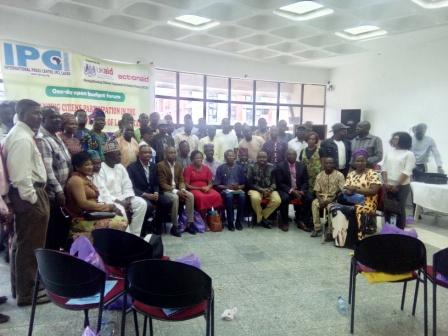

Communiqué of the Stakeholders’ Post-Election Forum on Lagos State Local Government Election Held on Thursday August 10, 2017 at All Seasons Conference Centre, Agidingbi, Ikeja, Lagos.
Communiqué of the Stakeholders’ Post-Election Forum on Lagos State Local Government Election Held on Thursday August 10, 2017 at All Seasons Conference Centre, Agidingbi, Ikeja, Lagos. COMMUNIQUÉ Introduction The International Press Centre (IPC) held a one-day Stakeholders’ Post-Election Forum on the recent Lagos State Local Government Election on Thursday, August 10, 2017 at the main hall of All Seasons Conference Centre, Agidingbi, Ikeja, Lagos State. The event was organized in furtherance of series of citizens engagement programmes for community members from eighteen (18) communities across six (6) Local Government Areas (LGAs) of Lagos State, namely, Amuwo Odofin, Surulere, Shomolu, Ikorodu, Lagos Mainland and Ifako-Ijaiye under the Strengthening Citizens Engagement in Electoral Process (SCEEP) project, being implemented in Lagos by IPC and supported by ACTIONAID Nigeria and the UKAID through the Department for International Development (DFID). Over 120 participants drawn from the communities as well as representatives of institutional stakeholders including the National Orientation Agency (NOA), the National Conscience Party (NCP), KOWA and ACCORD parties, election monitors/key CSO stakeholders, youth, women and People Living with Disabilities (PWDs) and the media attended the forum. Mr. Kehinde Bamigbetan, Special Adviser to Lagos Governor on Communities & Communications was special guest of honour while Dr. Abiola Akiyode-Afolabi, the Chair, Transition Monitoring Group (TMG), delivered the lead presentation on the theme, “Post analysis of Lagos State LG elections: Appraisal of stakeholders’ involvement- the issues, gaps and prospects for improvement”. Objective The objective of the forum was to assess stakeholders’ contribution towards the elections, identify the gaps and learn from the issues in order to have improvement in future elections. Messages, remarks & presentations The event was moderated by Mrs. Bridget Osakwe, Coordinator of West African Network of Peace Building (WANEP) and received goodwill messages from Mr. John Emah, representing Mr. Waheed Ishola, Director of Lagos State National Orientation Agency (NOA); Mr. Kehinde Bamigbetan, Special Adviser to Lagos Governor on Communities & Communications; SCEEP partners from Imo, Akwa Ibom, Kano and Kaduna States and representatives of three political parties – KOWA, NCP and ACCORD. In her paper, Dr. Abiola Akiyode-Afolabi, who is also the Executive Director of Women Advocates Research and Documentation Center (WARDC) gave an overview of the outcome of the monitoring of the elections. She said while it was good that the election was held there were issues with the legal framework, the conduct of the primaries, low participation, etc. Dr. Adewale Aderemi, Senior lecturer, Department of Political Science, Lagos State University (LASU) contributed to the presentation under the sub-theme, “Post analysis of the Lagos 2017 local government elections: Issues arising and way forward in advancing stakeholders role in deepening the electoral processes” and said the observations by Dr. Akiyode-Afolabi were worth addressing. Observations Following the remarks and presentations, participants during the plenary observed as follows: The local government is plays important role in a democracy as it is the tier of government closest to the grassroots but it is worrisome that attempts are being made to render local councils ineffectual There is the need to get democracy right at the local government level as only then can we get it right at the state and federal levels. There was evidence of lack of internal party democracy across some of the political parties as candidates were imposed in most cases which snowballed into violence during the party primaries. There was evident of citizens’ and voters’ apathy during the July 22 Lagos State local government elections such that the turnout of voters was very low. The citizenry have individual and collective stakes to make elections credible in Nigeria; election should not be seen as the business of government alone but that of everyone. Democracy will only work better if citizens take interest in and not to be nonchalant because being nonchalant, the citizens are disenfranchised and thus give room for politicians to legitimize what is illegitimate. Media reportage of the Lagos State local government elections was skewed in favour of the ruling political party to the detriment of other parties. Opposition political parties did not deploy sufficient formidable campaign strategies to counter the influence of the ruling party ahead of the elections. Recommendations/Resolutions Arising from the observations, participants recommended as follows: The State Independent Electoral Commissions (SIECs) should be made more independent, particularly in their financing, in order for them to be able to prepare adequately for local elections and obtain the level of trust people have in the Independent National Electoral Commission (INEC). Citizens’ stakeholder groups should insist on internal party democracy; at the minimum, parties should present candidates through consensus. Community development associations and committees should sensitize their members on the need to participate in the political process and not disenfranchise themselves. Persons living with disabilities should be taken into consideration in elections and their various needs addressed by the electoral commission. Sensitizations and voter education should also be sustained to address voter apathy and get citizens and voters to participate more in the electoral processes. Civil society organizations and related stakeholders should step up and increase interactions with more grassroots communities to reduce citizens and voters apathy. Communities in Lagos State should familiarize themselves with structures put in place by the state government to address grassroots developmental issues and make use of them Conclusion Participants at the Stakeholders’ Post-Election Forum on Lagos State Local Government Elections expressed gratitude to IPC and its partners; ACTIONAID and UKAID through the Department for International Development (DFID) for supporting the organization of the forum. Signed: Lanre Arogundade Director, International Press Centre (IPC) Lanre Arogundade Director Tel: +234 (0) 8023186845 , +234 (0) 8067144874 Email: larogundade@ipcng.org, larogundade@gmail.com Twitter: @lanreipc l Skype: lanre.arogundade2 International Press Centre (IPC), Lagos, Nigeria IPC is Nigeria’s foremost media capacity development organization. www.ipcng.org l www.twitter.com/IPCng l www.facebook.com/ipc.nigeria l www.youtube.com/ipcng l Google+ : Ipc Ng
Uncategorized
IPC CONDEMNS GRUESOME KILLING OF JOURNALIST FAMOUS GIOBARO, CALLS FOR URGENT INVESTIGATION
The International Press Centre (IPC), Lagos-Nigeria has condemned the brutal murder of Mr. Famous Giobaro, of the Bayelsa State-owned radio station, Glory FM 97.1, who was shot dead by unknown gunmen at his residence on Sunday, April 16, 2017. Giobaro, who worked as a Desk Editor in the station, was reportedly attacked in his house located in a mini estate at the INEC Road area in Yenagoa, the state capital, by unknown gunmen who broke into his apartment around 5:00a.m. and shot him many times in the stomach at close range and left without stealing anything. It was gathered that the killers gained access to his house by climbing the fence through a ladder after cutting the barbwires. Director of IPC, Mr. Lanre Arogundade in a statement today (April 17, 2017), said that the killing of the journalist brings to fore serious concerns for the safety of journalists in Nigeria. “We are calling on the Bayelsa State Government to show commitments and investigate the alleged assassination of Journalist Giobaro who is a staff of the state government. This is one incident that should not be allowed to lie low and we also call on the Inspector General of Police to investigate the matter with a sense of urgency”, Arogundade stated. According to Arogundade, the killing has again reinforced IPC’s beliefs that journalists’ are under threat in Nigeria. “We have had many unresolved issues with journalists in recent past and it will be a rape on democracy under this dispensation if a journalist can just be gunned down in such a manner’, Arogundade added while sympathizing with family members of the journalist and the Bayelsa State Council of the Nigerian Union of Journalists in particular. Signed: ‘SANMI FALOBI Programme Associate

AFEX members call for internet shutdowns in Africa to stop
AFEX members call for internet shutdowns in Africa to stop African media rights organisations have called for internet access to be recognised as a human right and for African governments to stop shutting off the internet when it suits them and cutting off freedom of information to citizens. There have been 16 recorded internet shutdowns in Africa in the first half of 2016. AFEX members in Grahamstown, South Africa The African Freedom of Expression Exchange (AFEX) held its 4th Annual General Meeting (AGM) in Grahamstown, South Africa, recently. The AGM was preceded by a two-day capacity building training workshop on Digital Rights Advocacy for AFEX member organisations, as a follow up to a similar workshop held in Accra, Ghana, in January 2016, for African freedom of expression and media rights organisations. The two-day capacity building training was held on the sidelines of the 20th edition of the Highway Africa Conference, organised by the School of Journalism and Media Studies at Rhodes University in South Africa with the theme: ‘The Internet and the Media – Celebrations, Reflections and the Future’. The Highway Africa Conference is the largest annual gathering of African journalists in the world. The objective of the AFEX workshop was to build the capacity of African freedom of expression and media rights organisations to enable them to more effectively promote and defend freedom of expression and human rights on the continent, especially in the online and digital environments. The training was motivated by the need for the AFEX network to increase its engagement in digital rights advocacy in Africa amidst increasing incidents of internet or social media shutdowns; continuing attacks on journalists online and offline, accompanied by impunity for such crimes against journalists and other human rights defenders; as well as the need to safeguard of freedom of expression in Africa as a necessary corollary to democratic consolidation. As part of its participation in the Highway Africa Conference, AFEX presented two sessions, the first being a panel discussion on the topic: ‘Confronting the Media Sustainability Challenge in Africa’ at a parallel workshop on the first day of the conference. The second was another panel discussion at a plenary session on the second and final day titled ‘Hands Off Our Internet: Internet Regulation and Journalism in Africa’. AFEX resolutions AFEX member organisations in attendance at the AGM and the training, observed that internet shutdowns have become a common and regular instrument adopted by several African governments to stifle free speech during important national events, particularly elections. They cited the findings contained in a report issued by the Collaboration on International ICT Policy in East and Southern Africa (CIPESA), a leading centre for research on ICT policies in Africa. The report indicated that there have been 16 recorded incidents of internet shutdowns during the first half of 2016 (January to June). AFEX members described the trend as very worrying. In particular, they cited some of the latest examples of such incidents as taking place in Uganda, Burundi, Ethiopia, Zimbabwe, Congo Brazzaville, the Democratic Republic of Congo, Chad, Tunisia, Mali, with the latest being Gabon. AFEX members added that these countries have shut down the internet during general elections, protests or other national events and that in all these incidents, the free expression rights of citizens have been violated as they are deprived of the right of access to information, in addition to interference with other human rights. AFEX members endorsed efforts by the United Nations Special Rapporteur on the rights to freedom of opinion and expression, David Kaye, to get State actors and the private sector to work closely together to ensure the existence of a free and open internet. Internet access as a human right However, they expressed concern that access to the internet has yet to be officially recognised by the United Nations as a human right, despite resolutions by UN bodies guaranteeing freedom of expression, the right to privacy and other human rights online. AFEX Members therefore called on the UN to expedite processes at the level of its General Assembly to formally pronounce internet access a human right given its centrality to the exercise and enjoyment of human rights online as well as to development. They commended UNESCO for proclaiming September 28 of every year as the “International Day for Universal Access to Information”, noting that African leadership, both at the level of governments and civil society, led to the proclamation of the day. AFEX Members called on African governments to take advantage of the first official celebration of the day later this September to guarantee their citizens access to information. They called on countries that are yet to adopt access to information laws to do so as a matter of urgency while those which already have such laws were urged to take measures to ensure their effective implementation. Digital rights The members reaffirmed the commitment of AFEX to Digital Rights and Freedoms as well as the safety of journalists in Africa and resolved to campaign against internet shutdowns across the continent. A new Steering Committee was elected during the General Meeting to lead AFEX over the next two years. Members elected included Edetaen Ojo, executive director of Media Rights Agenda (MRA) in Nigeria, as chairperson of the Steering Committee. Other elected members are: Gilbert Sendugwa of the African Freedom of Information Centre (AFIC) in Uganda; Tuver Wundi of Journaliste en Danger (JED) in the Democratic Republic of Congo; and Sulemana Braimah of the Media Foundation for West Africa (MFWA). AFEX members also admitted three new members into the network, namely, the International Press Centre (IPC) in Nigeria; the Institute for Media and Society (IMS), also in Nigeria; and the Association for Media Development in South Sudan (AMDISS), based in South Sudan. Other members represented at the AFEX meeting were Human Rights Network for Journalists in Uganda (HRNJ), the Centre for Media Studies and Peacebuilding (CEMESP), the National Union of Somali Journalists (NUSOJ) and the Media Institute of Southern Africa (MISA). AFEX is a continental network of prominent