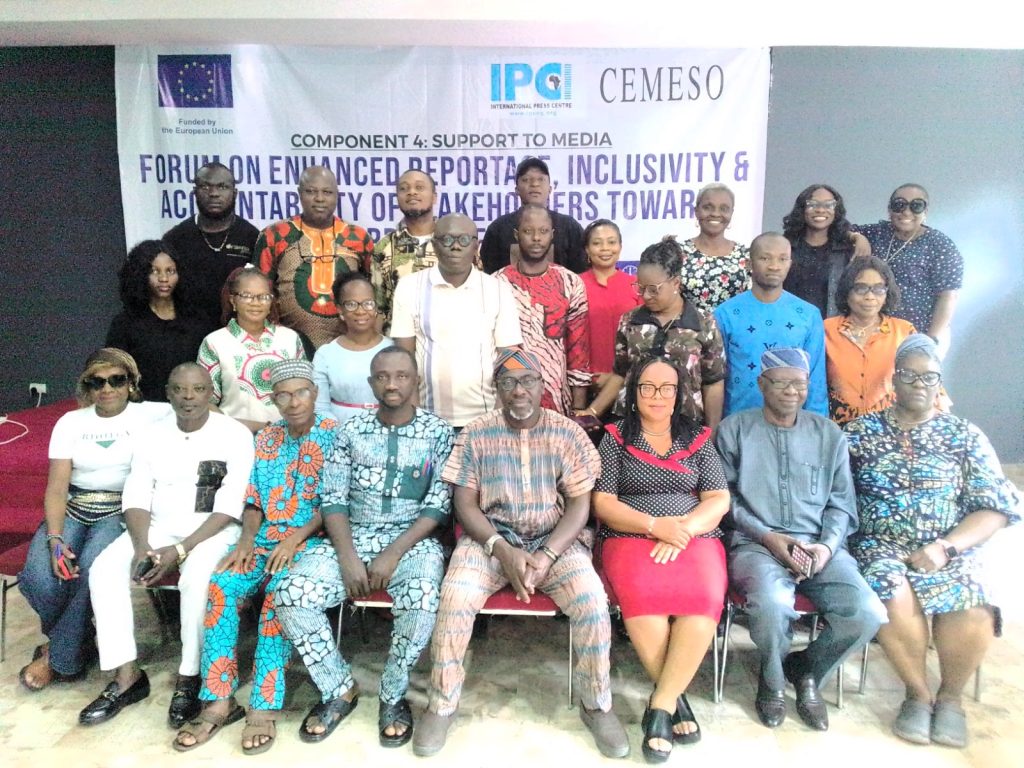
Journalists, security agencies, and civic stakeholders unite ahead of November 8 polls to ensure peaceful, inclusive, and credible election coverage. Stakeholders at the EU–SDGN II stakeholder forum With more than 2.8 million registered voters expected to cast their ballots across 5,718 polling units in Anambra’s 21 local government areas on November 8, 2025, the demand for reliable, ethical, and inclusive election information has never been greater. Yet elections today unfold in an increasingly volatile information environment, one where misinformation, digitally engineered propaganda, and AI-generated falsehoods circulate faster than verified facts. Across Nigeria, coordinated disinformation campaigns now deploy deepfakes, manipulated videos, fabricated statements, and hyper-segmented political messaging designed to exploit voter identities such as religion, gender, ethnicity, and political affiliation. These efforts make it easier for bad actors to polarize communities, distort public opinion, and influence electoral outcomes. This kind of information pollution threatens not only the credibility of elections but also the broader democratic fabric that supports public trust. At the same time, the safety of journalists remains a pressing concern. Media professionals increasingly operate in environments marked by intimidation, harassment, equipment seizures, online abuse, and physical threats, risks that intensify during election periods. Press freedom faces constant pressure, and journalists must navigate political interference, ownership influence, and hostile reporting conditions while maintaining accuracy and impartiality. Without their safety and independence, the public cannot receive the factual and timely information it needs to make informed decisions. It was within this complex landscape of rising digital threats, shrinking civic space, and heightened risks to media practitioners that the International Press Centre (IPC) and the Centre for Media and Society (CEMESO) convened a two-day multi stakeholder forum supported by the European Union within the European Union Support to Democratic Governance in Nigeria (EU–SDGN) Programme Phase II. The engagement was designed to strengthen ethical journalism, reinforce press freedom, enhance the safety of reporters, and foster coordinated collaboration among journalists, INEC, security agencies, civil society organizations, and other electoral stakeholders. Ultimately, the forum was anchored in a central truth. Protecting the integrity of the November 8 governorship election begins with protecting the information ecosystem and safeguarding the journalists who stand at its frontlines. Held at BON Hotel Smith in Awka, the forum brought together journalists from the print, broadcast, and online sectors along with representatives of the Independent National Electoral Commission INEC, the Nigeria Police Force, the Nigeria Security and Civil Defence Corps NSCDC, the National Orientation Agency NOA, media unions, civil society groups, and development partners. Collectively, they examined critical issues affecting electoral credibility, including misinformation, journalist safety, stakeholder coordination, inclusive reporting, and the urgent need for reliable voter education. Media Ethics, Professionalism, and Issue-Based Reporting at the Forefront The opening day of the forum highlighted the indispensable role of the media in shaping democratic outcomes. Speaking at the event, Mr. Lanre Arogundade, Executive Director of IPC, said the engagement is part of Component 4: Support to Media under the EU-SDGN II programme, jointly implemented by IPC and CEMESO. He noted that the component complements EU-SDGN support to INEC, political parties, youth, women, and persons with disabilities (PWDs) toward delivering credible and inclusive elections. Arogundade stressed that elections are the bedrock of democracy, and the media plays a central role in helping citizens make informed choices. He said journalists must uphold fairness, accuracy, inclusivity, and professionalism, in line with the Electoral Act 2022, the Nigeria Broadcasting Code, and the Nigerian Media Code of Election Coverage. He explained that the forum aims to strengthen issue-based reporting, ensure fairness in covering campaign promises, and equip journalists to counter misinformation, disinformation, and press freedom violations. Arogundade urged all electoral stakeholders to act responsibly, avoid bias, and remain accountable, stressing that government and security agencies must provide a safe and enabling environment for journalists, including access to information and justice for attacks on reporters. He added that political parties must also support credible media coverage, refrain from attacks on journalists, and ensure the media can work freely and professionally throughout the election period. Dr. Akin Akingbulu, Executive Director of CEMESO, described the forum as a timely intervention for an election that is sensitive and vulnerable to misinformation and political interference. He warned about the rising threats of disinformation, AI-driven fake news, and recycled insecurity narratives, and stressed that journalists must embed fact-checking into their routine newsroom culture. Dr. Akingbulu also called for stronger protection for journalists, noting that “the integrity of democratic processes is tied to the safety of those who report them.” A standout moment of the first day of the forum came with a compelling presentation by Dr. Njideka Ezeonyejiaku of Nnamdi Azikiwe University, titled “Embedding Ethics, Professionalism, Inclusion, and Issue-Focused Reporting Before and After the Anambra Governorship Election.” She emphasized the critical role of journalism in empowering citizens, providing them with accurate, timely, and objective information necessary to make informed decisions. Ethics and professionalism session with Dr. Ezeonyejiaku Dr. Ezeonyejiaku highlighted that ethics in journalism involves maintaining fairness, balance, and truth in every report. Professionalism, she explained, requires the consistent application of established journalistic principles and rules to ensure credibility. Inclusion, she stressed, demands that all voices are heard, particularly those of women, youth, the elderly, marginalized communities, and persons with disabilities, so that election coverage reflects the entire society. She also underscored the importance of issue-focused reporting, urging journalists to move beyond political personalities and campaigns to shine a light on pressing development concerns, including healthcare, education, infrastructure, social welfare, and governance. By adopting fact-driven, people-cantered storytelling, Dr. Ezeonyejiaku argued, journalists can foster public trust and strengthen democratic accountability, ensuring that media coverage contributes positively to the electoral process. Stakeholders Outline Election Preparations and Collaborative Measures Stakeholders at the forum engage on election issues. Day Two of the forum brought together the full spectrum of stakeholders responsible for ensuring a credible Anambra election, creating a space where strategy, accountability, and public service intersected. Journalists, security agencies, civil society actors, and INEC officials engaged in frank conversations about readiness, collaboration, and the shared